SpaceX chief executive Elon Musk succesfully launched Falcon Heavy, the world’s most powerful rocket, which carries a Tesla roadster which is yet to be launched by Tesla motors, heading toward an orbit near Mars.

Also they achieved a unique feat as it is first time that a rocketing firm has managed to guide at least two of the Falcon Heavy’s first-stage rocket boosters to land upright back on Earth. Also it’s the first time that a car is being sent to the space. On the driving seat of the car is a dummy dressed in a spacesuit named Starman and the words “DON’T PANIC” are written on the dashboard.
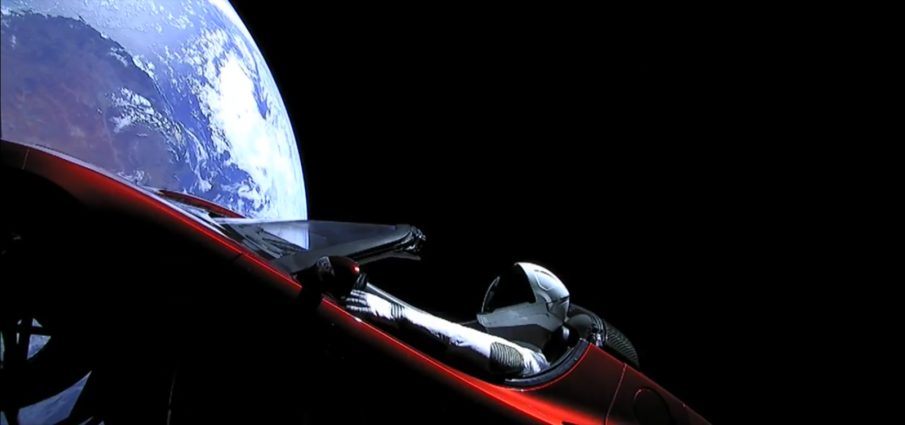
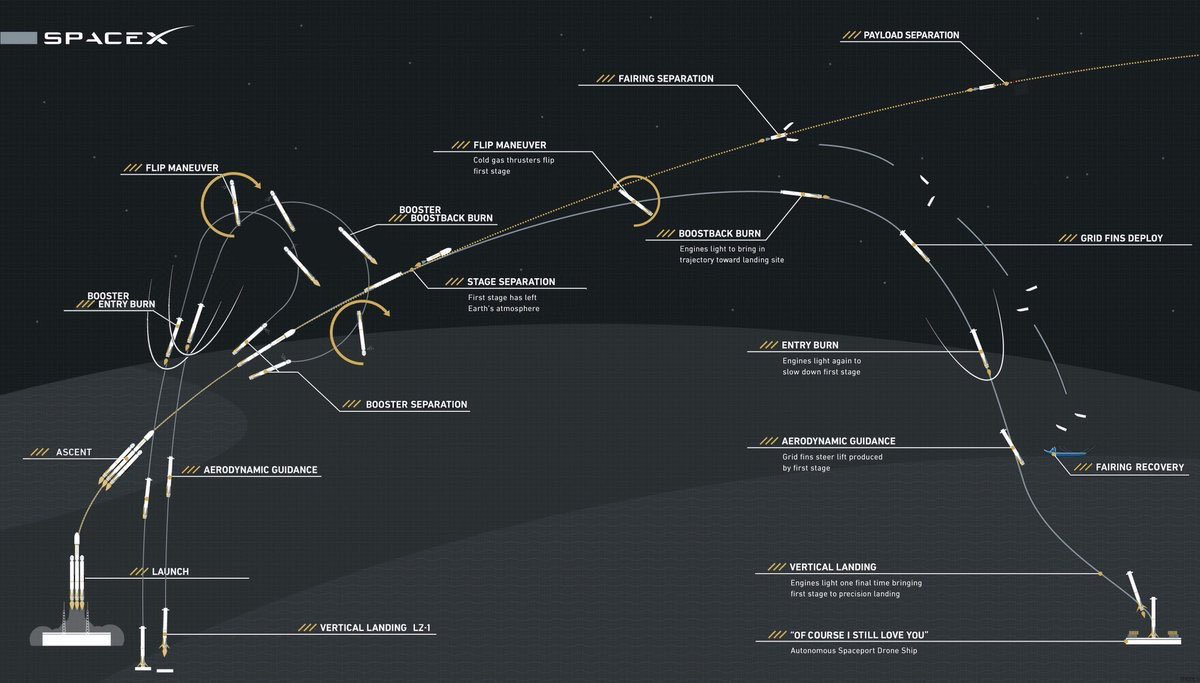
Elon Musk previously said that one of the most critical points of the flight would come as two side boosters that gets separated from the central rocket within three minutes of launch. That occurred smoothly without a glitch.
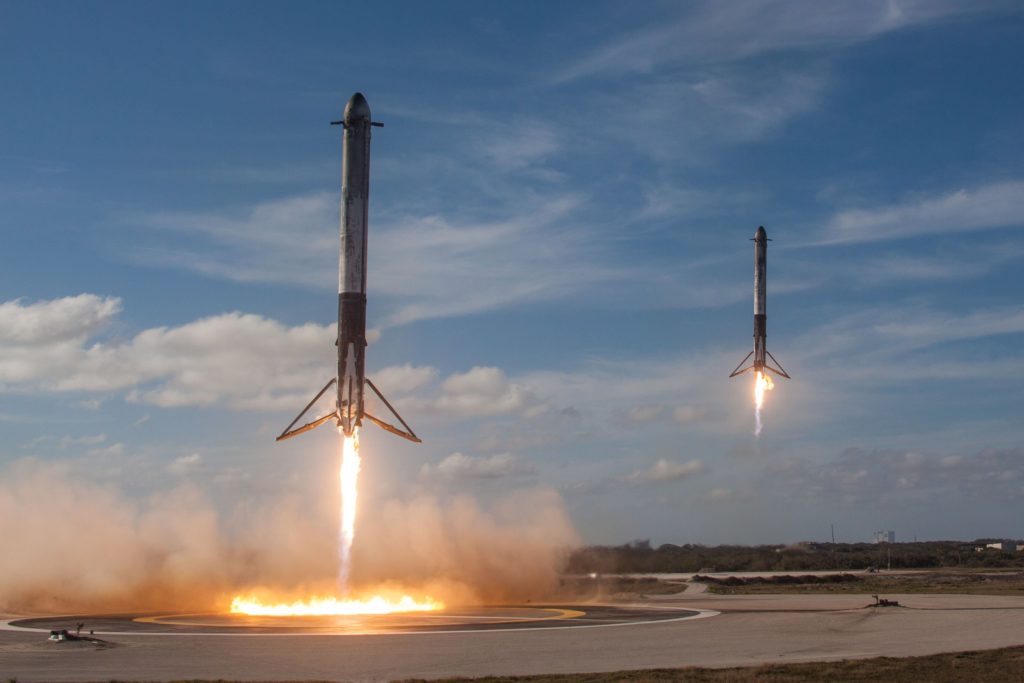
Based on the principle of cost-cutting reusable rocket technology mastered by SpaceX, the two side boosters flew back to Earth for safe simultaneous landing on twin landing pads at Cape Canaveral Air Force Station, eight minutes after their launch. The center booster was expected for a return landing on a drone ship floating at sea, but its fate was not immediately known.
Falcon Heavy is designed to place up to 70 tons into standard low-Earth orbit at a cost of $90 million per launch. That is twice the lift capacity of the biggest existing rocket in America’s space fleet – the Delta 4 Heavy of rival United Launch Alliance (ULA), a partnership of Lockheed Martin Corp and Boeing Co – for about a fourth the cost.
The demonstration flight put the Heavy into the annals of spaceflight as the world’s most powerful rocket in operation, with more lift capacity than any space vehicle to fly since NASA’s Saturn 5, which was retired in 1973, or the Soviet-era Energia, which flew its last mission in 1988.
Propelled by 27 rocket engines, the Heavy packs more than 5 million pounds of thrust at launch, roughly three times the force of the Falcon 9 booster rocket that until now has been the workhorse of the SpaceX fleet. The new rocket is essentially constructed from three Falcon 9s bolted together side by side.
The launch followed an impressive run of successful paid missions – 20 in all since January 2017, when SpaceX returned to flight following a 2016 launchpad accident that destroyed a $62 million rocket and a $200 million Israeli communications satellite that it was to put into orbit two days later.
Musk said he hoped Tuesday’s achievement would encourage a new “space race” by private ventures and other countries, an allusion to the 1960s Cold War contest between the United States and the Soviet Union.
“Space races are exciting,” he said.
SpaceX had previously announced plans to eventually use Falcon Heavy to launch two paying space tourists on a trip around the moon. Musk said on Monday he was now inclined to reserve that mission for an even more powerful SpaceX launch system, the Big Falcon Rocket, or BFR, whose development he said was proceeding more swiftly than expected.