

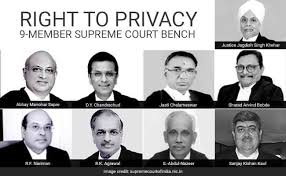
Right to Privacy unanimously declared as Fundamental right. As by a nine Judge constitutional bench of Supreme Court in Puttaswami Vs Union of India case 2017.The petitioner appealed that the collection of information under Aadhar is a violation of Right to Privacy. There can be no dignity without Privacy . Therefore dignity is a part of Preamble as well as part of basic structure of the constitution.
Challenges for Right to Privacy in technological era
Also, CIA recently reports that 40% of Indian mobile users give away their data unknowingly. Coming to International obligation Art 12 of universal declaration on human right and Art 17 of the International covenant on civil. As a result, political right also provides furthermore for Right to Privacy . The government database like NATGRID is classified among the Intelligence and security organization. According to supreme court guidelines data protection mechanism is very much necessary . Thus, Justice B.N. SRI KRISHNA committee identify key data protection issue. He suggest to draft data protection issue bill is, in the line of supreme court. In addition it respects international laws and treaties mentioned in (DPSPs Art 51).
True Implication of the Judgement
If we see the future of Aadhar and DNA profiling bill remains uncertain too. Talking to internal security Right can be proxy based cyber crimes, identify fraud, separatist using to spread rumour. In the first place, it can also open a debate regarding abortion rights of women, euthanasia besides practicing of Santhara. This becomes hurdle in the functioning of welfare schemes requires personal data of citizens. Furthermore in SEC 377 As per the verdict of supreme court in Kaushal case finally LGBT right can also be included.

Major highlights in cases of Right to Privacy
First in Govind vs State of MP 1975- SC opined that right to privacy was not absolute. Second, MP Sharma vs Satish Chandra 1984-right to privacy was not recognized by Supreme court . Likewise, In Raj Gopal vs State of Tamil Nadu 1994 case Supreme Court held that the right to privacy is a part of right to protection of life and personal liberty under Article 21.


