

12 new moons of Jupiter were accidentally discovered by astronomers looking for a 9th planet in the solar system. These are 12 really small moons, not more than 3-4 miles long. The team found the new moons by accident thanks to an unplanned alignment of Jupiter with their initial research project and some recently installed telescope technology.
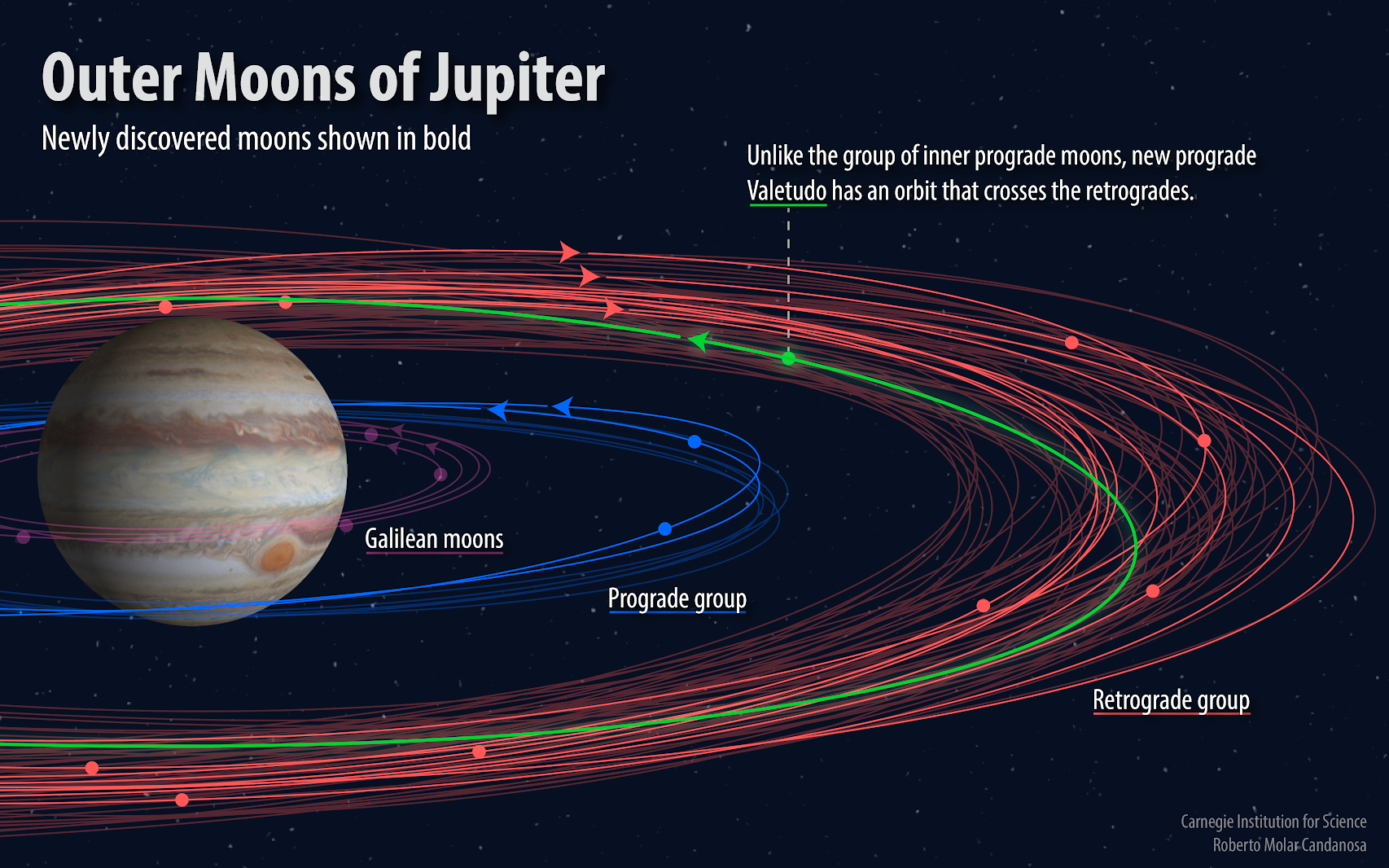
The dozen new moons range in size from roughly one to three miles across. Two of the moons are clustered relatively near the planet, and they orbit in the same direction the Jupiter spins in. A theory suggests that they are likely to be remnants of a much larger moon which got destroyed over billions of years since the birth of the solar system.
Here’s how they appear!!!
Who discovered them?
Scott Sheppard and his team of colleagues from the Carnegie Institution for Science discovered the 12 new moons. When asked how did this happen Scott said that they were using the 4 meter Victor Blanco telescope in Chile in March and realized that Jupiter was right near the part of the sky where he wanted to search.
“So we could also search for Jupiter moons while looking for things that are well beyond Pluto,” Sheppard says.
He told that one thing that really helped in searching of the moons was the especially large camera attached to the Blanco telescope. It was the camera that helped them to search the moons in such few images.
The oddball is the smallest of the moons, just 1 Km across. Sheppard and his colleagues have proposed naming the oddball moon Valetudo, after a minor goddess and great-granddaughter of the Roman god Jupiter. Even though a dozen new moons is a pretty good haul, Sheppard expects that more searching will turn up even more moons. Maybe 100 or more of the really small ones.
As per every-time along with the discovery, several questions were raised like “Can the oddball which is just 1 km across be called a moon?”
Sheppard agreed that it’s problematic. “Maybe there will have to be a new definition for the smaller moons. Maybe a dwarf moon for anything that’s 1 kilometre in size or smaller,” he says.


