

I was at a party the other night with several people who knew I’d just been to iOS Apple’s annual iPhone launch event. After asking me tons of questions about the new iOS Apple Park campus, they of course asked about the new iPhone — by which all of them meant the all-new iPhone X. More than one person didn’t even know the iPhone 8 existed.
Their focus — and really, iOS Apple’s focus — is on the iPhone X, the phone with the complete redesign, the edge-to-edge display, the facial-recognition system, and the entirely new interface patterns developed around the removal of the home button.
The iPhone 8 doesn’t have any of that. While the 8 and 8 Plus share a processor, wireless charging capability, and similar camera setups to the X, they lack any truly new ideas about what an iPhone is — they’re both very much just the next step along a path Apple’s been on for quite some time now.
But Apple will ship millions of iPhone 8s — to people on upgrade plans, people who don’t want to pay $999 for an iPhone X or wait for what seems like limited availability, and people who just need a new phone without thinking about it too much. If the iPhone X is Apple’s bold vision of the future, the iPhone 8 is Apple making sure everyone else at the party has a nice time too. If you know what an iPhone is and you want one, then the iPhone 8 is exactly that, one tick farther down the line. It’s an iPhone.
/cdn.vox-cdn.com/uploads/chorus_asset/file/9276181/jbareham_170915_2000_0020.jpg)
DESIGN
The iPhone 8 is fundamentally the fourth generation of the iPhone 6 — Apple told us it thinks of the 8 as an “all-new design,” but that’s also what Apple said about the iPhone 6S and 7. It must take a lot of effort to keep reinventing the same basic design without actually changing it. The major difference you’ll notice is the glass back, but other than that nothing has changed — the 8 and 8 Plus will fit right into 7 and 7 Plus cases perfectly.
That glass back is heavier than the aluminum on the 7, but it’s not bad — in fact, I like how the combination of the glass and increase in weight make the phone easier to hold than the 6 and 7, which always felt like they were about to fly out of my hand. You don’t need a case for these new phones, but you’ll probably want one: Apple claims the glass is stronger than ever, but I’ve already scratched the 8 Plus by carrying it around in my pocket. We’ll see what happens when millions of people around the world start dropping these things.
The iPhone 8 comes in three colors — I received gold and silver phones to review. The silver is pretty familiar, but the gold isn’t exactly what you’d expect. The back is a very 70s-looking cream color, which several people I showed it to really liked. It might even appease those mourning the loss of the rose gold option.
At the end of the day, you’re looking at the same basic idea as the iPhone 6, and the iPhone 6 is far from the most beautiful iPhone Apple has ever made. I’ve been calling out the basic clunkiness of the 6 design since the 6 came out in 2014, when I wrote that “The iPhone 6 Plus isn’t beautiful the way the iPhone 4 was beautiful.” In 2015, I wrote that the iPhone 6S Plus “feels particularly surfboard-y” and that it was “almost designed to be put in a case.” And last year, I wrote that “nothing about the iPhone 7’s design exceeds the rest of the industry.”
And that’s really the problem — while competitors like Samsung and LG have pushed phone hardware design far forward, the iPhone has basically stood still for four years. The iPhone 8 might be the most polished iteration of this basic design Apple’s ever made, but compared to the Galaxy S8 and other Android flagships like the LG V30, it’s just extremely dated. Apple’s true competitor to those devices is the iPhone X, but the company tells us that the 8 is also a flagship phone, and those huge bezels and surfboard dimensions just don’t cut it at the top end of the market anymore.
The Galaxy S8 is just a tiny bit bigger than the regular iPhone 8, but it has a larger screen than the iPhone 8 Plus, doesn’t have a camera bump, and generally feels like a tighter and sleeker package. I don’t love Samsung’s riffs on Android, but there’s no question that the S8 is a nicer piece of hardware than the iPhone 8. And it’s not just OLED phones that are moving past bezels — the Essential Phone has an edge-to-edge LCD screen. It seems clear that Apple’s put all of its design energy into the iPhone X, and that means the 8 suffers in comparison.
But of course, it just doesn’t matter if you have no intention of switching away from iOS, or you’re locked into iMessage. Android phones might as well not even exist for you. The thing to know is that spending money on an iPhone 8 doesn’t get you the cutting edge of phone design, or even Apple design — for that, you’ll have to get an iPhone X.
/cdn.vox-cdn.com/uploads/chorus_asset/file/9275475/jbareham_170916_2000_0206.jpg)
DISPLAY AND SPEAKERS
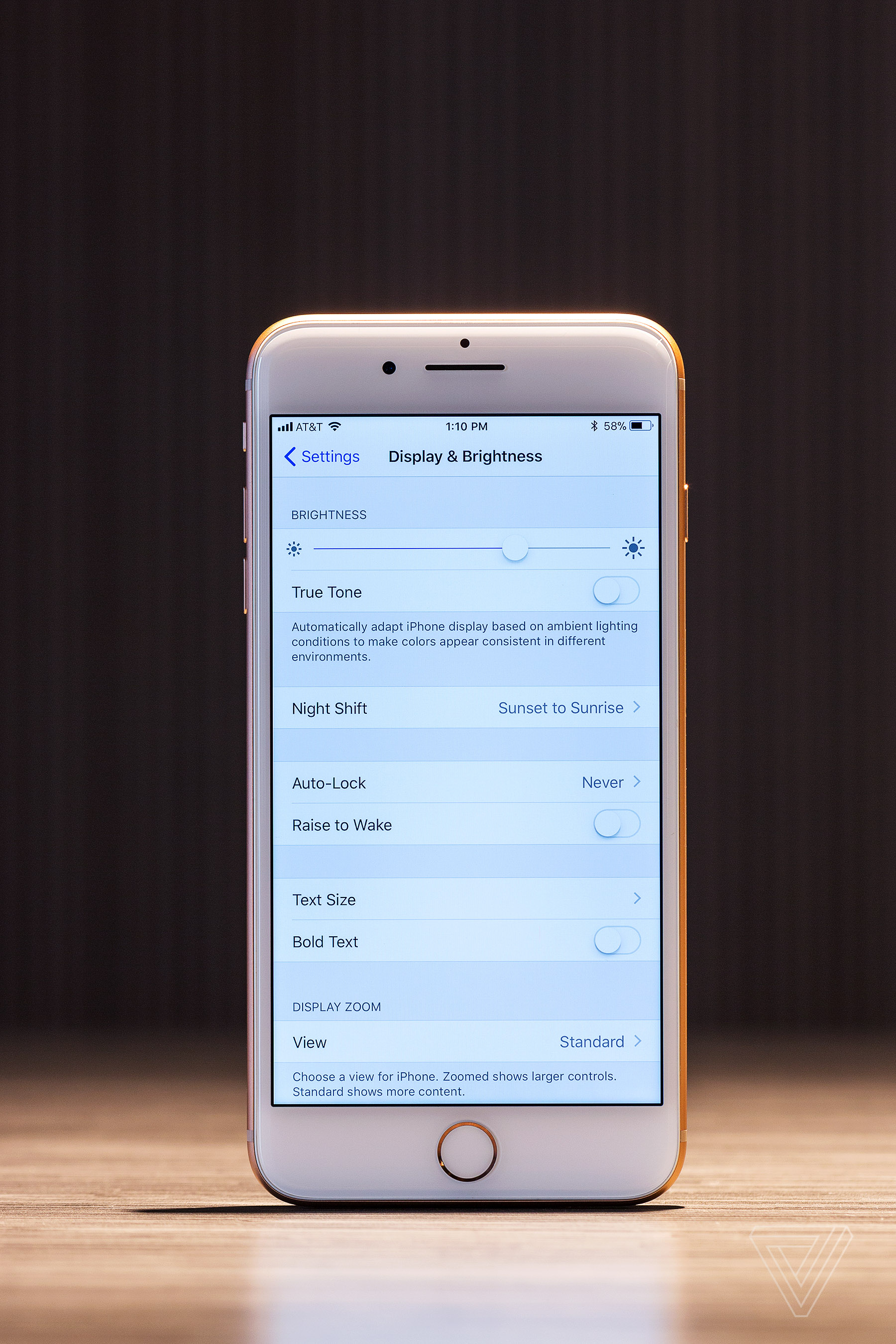
Apple’s added True Tone tech to the iPhone 8 display, which first appeared on the iPad Pro. I’ve always thought the iPhone LCD was the best overall display on the market in terms of color accuracy, and True Tone just makes it look better, by measuring ambient light with sensors on the front of the phone and adjusting color temperature on the fly. You won’t notice it working while it’s on, but if you obsessively click the button on and off under most indoor lighting you’ll see things warm up a little when it’s active.
The iPhone 8’s upgraded stereo speakers are impressively good. Just as on the iPhone 7, the earpiece gets really loud to act as the second speaker, but the whole system gets up to 25 percent louder now. You can hear actual stereo separation, which is wild.

True Tone Off/On
Photo by James Bareham / The Verge
Bluetooth has been updated to Bluetooth 5, so future wireless headphones and (in particular) future smart home devices should be a little more reliable. There’s no Bluetooth 5 stuff out yet, so we’ll have to see how it goes, but it’s ridiculous that iOS 11 barely improves the Bluetooth device management interface beyond a new toggle in Control Center’s music widget. Wireless audio all around is just messy in iOS unless you limit yourself to one of Apple’s five W1-enabled headphones, which pair and sync much more cleanly than third-party products. If you have a lot of speakers and headphones, you will spend more time bouncing around settings and apps than you ever really want to. It’s all due for a complete rethink.
And I would be remiss if I didn’t point out that there’s no headphone jack, which is still routinely annoying on every phone that omits it. Apple’s own headphone dongle is one of the lowest-rated products on the Apple Store, with just 1.5 stars. It’s been a year, and the Lightning audio ecosystem is still extremely immature. All the more reason for Apple to clean up all those wireless audio settings.
/cdn.vox-cdn.com/uploads/chorus_asset/file/9275847/jbareham_170916_2000_0172.jpg)
WIRELESS CHARGING AND BATTERY LIFE
The glass back allows for wireless charging, based on the Qi standard. Apple gave me one of the Mophie charging pads it’ll be selling in stores, and we tried it out on Qi pads from Samsung as well, and it all just worked.
Qi is pretty slow, though — Apple’s goal is to match the charging speed of its own 5W pack-in charger, but I only saw about 15 percent more charge on the 8 Plus every 30 minutes with the Mophie, which is especially pokey when you consider that you can’t pick up and use your phone during that time. A future iOS update will let the iPhone 8 draw more power out of the Mophie and Belkin pads Apple sells in stores, so hopefully things speed up when that happens.
The iPhone 8 also supports fast charging for quick top-offs, which seems much more useful — any higher-powered charger will work, according to Apple, but you’ll see best results if you plug into a 29W USB-C MacBook charger, which will net you 50 percent charge in 30 minutes. Other chargers are similarly speedy, though: I saw 40 percent more charge on the 8 Plus in 30 minutes connected to an iPad charger. But you’ll have to buy a high-powered wall charger separately to see those speeds — in the box is the same 5W brick that has come with the iPhone since time immemorial.
Wireless charging will be nice at night on a bedstand, and I think it’ll be especially useful in cars, where you can just put the phone on the charger, connect wirelessly to Bluetooth, and be on your way without any cables at all. We tested it out in a new Prius Prime and it worked fine, but the phone got extremely warm. Apple told me that’s normal for some charging pads, and the the phone will stop charging if it gets too hot.
/cdn.vox-cdn.com/uploads/chorus_asset/file/9275839/akrales_170918_2000_0047.jpg)
Testing wireless charging in a Prius
Photo by Amelia Holowaty Krales / The Verge
If you’re a CarPlay user, you’ll still be plugging in, though: the only car on the market right now with both wireless charging and wireless CarPlay is the BMW 7 series. I’m sure there’ll be more to come, but unless you’re ready for a pretty intense new car purchase, you’re living with the wire.
Oddly, the iPhone 8 and 8 Plus have slightly smaller batteries than the iPhone 7 and 7 Plus. Apple says both phones should last about the same on a charge as the older models, because the A11 chip is more efficient than the A10. Both my iPhone 6S and iPhone 7 saw significantly worse battery life after just a few months, so we’ll have to see how the 8s do over time. But in these first few days of testing, everything seemed about the same as before, with just under a day of standard use on a charge. The battery drained far more quickly when we ran AR apps non-stop, which makes sense. And you can add the switch for low-power mode to control center now, which is very convenient if you routinely need to save power.
/cdn.vox-cdn.com/uploads/chorus_asset/file/9275435/jbareham_170916_2000_0140.jpg)
CAMERAS
Over the past year, the S8 and Pixel pulled ahead of the iPhone 7 in various tests. Apple told me they don’t look at benchmarks closely, but the images from the iPhone 8 camera definitely look more like Apple’s competitors than before.
Like Samsung, iPhone images are now more saturated by default, although Apple says it’s still aiming for realism instead of the saturated colors and smoothing of the S8. And HDR is just on all the time, like the Pixel — you can’t turn it off, although you can set it to save a non-HDR image as well. We ran around shooting with an iPhone 8, a Pixel XL, and S8, and iPhone 7 on auto, and the iPhone 8 produced the most consistent and richest images of the group, although the Pixel was the clear winner several times, especially in extreme low light. We’ll do a hardcore comparison test when the Pixel 2 comes out.
I didn’t spend much time testing out the new video modes, which include 60fps 4K shooting and 240fps 1080p slow motion. We’ll do an in-depth followup on that later.


